One connector family, a dozen names, and no agreement between vendors. This guide maps the aliases onto the actual interfaces and gives you the numbers that decide whether two parts will mate. Where sources conflict, the conflict is shown rather than resolved, so sample the parts before you commit a board.
Rev 2026-08 · 50 Ω unless noted · dimensions in mm
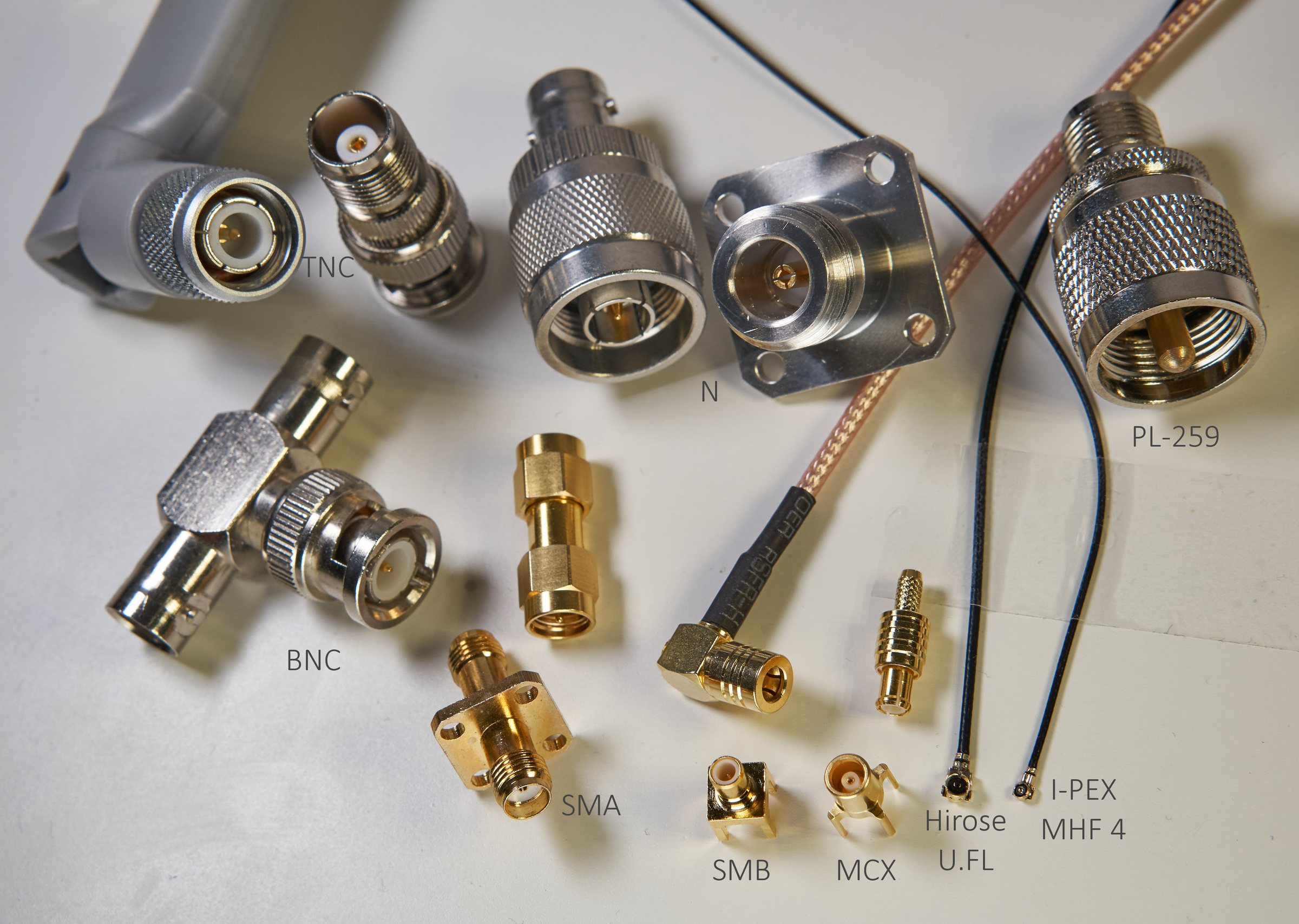
How small these are: U.FL and MHF 4 at bottom right, next to SMA, SMB, MCX, and the much larger BNC, TNC, N and PL-259. Photo: Shabaz1000, CC BY-SA 4.0
Look it up
Type whatever the listing or datasheet calls it.
Will they mate?
Cross-section drawn from the dimensions in the table. Outer sizes are to scale; internal shapes are schematic.
What fits?
Set your limits, or drag the lid line on the chart. The chart and the table below both follow.
Mated height off the board, in mm, on one scale. Select a bar to open that connector.
Reference table
Size mm
Cable OD
Nothing else
3
2.8 sq. 3.4×3.4 land
DC – 2 GHz
30 (typ.)
0.81 / 1.32 mm
No openly licensed photo of this part turned up, so none is shown rather than a look-alike. Check the maker's datasheet.
The oldest and largest of the Hirose .FL family. Bigger footprint than U.FL for less bandwidth, so you will only meet it on legacy hardware.
Coupling
Plug cap snaps over the jack
Contacts
Jack carries the pin (male); plug carries the socket (female)
Body
2.8 mm square
Land
3.4 × 3.4 mm
Plug / pin
Ø2 / Ø0.5 mm
Impedance
50 Ω
Also sold as
Hirose H.FL
IPEX 1U.FL family
2.5
2.6 sq. 3×3.1 land
DC – 6 GHz (Hirose) DC – 9 GHz (I-PEX MHF I) to 18 GHz U.FL(A), unconfirmed
30
0.81 / 1.13 / 1.32 / 1.37 mm (MHF1 also RG-178, RG-174)
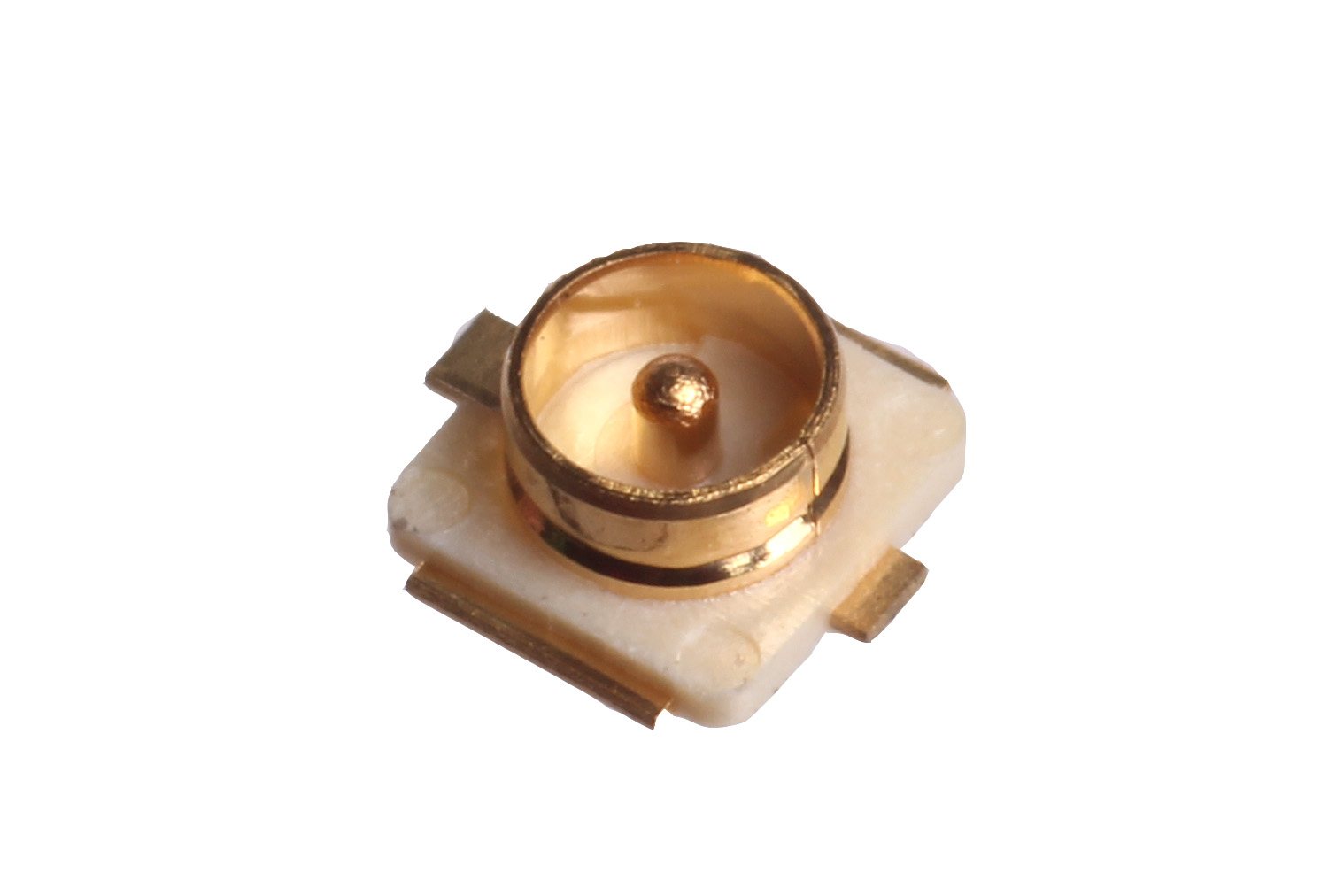
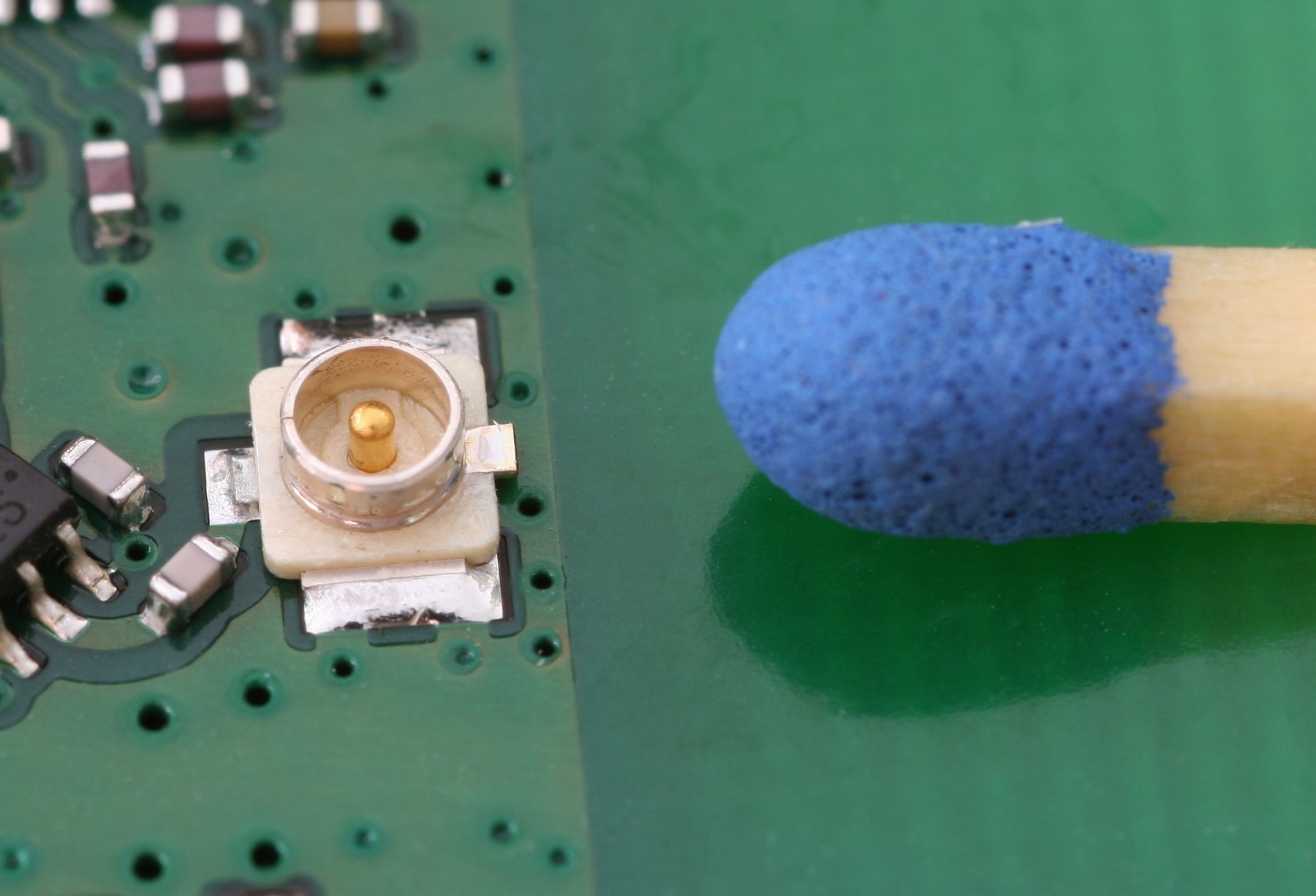
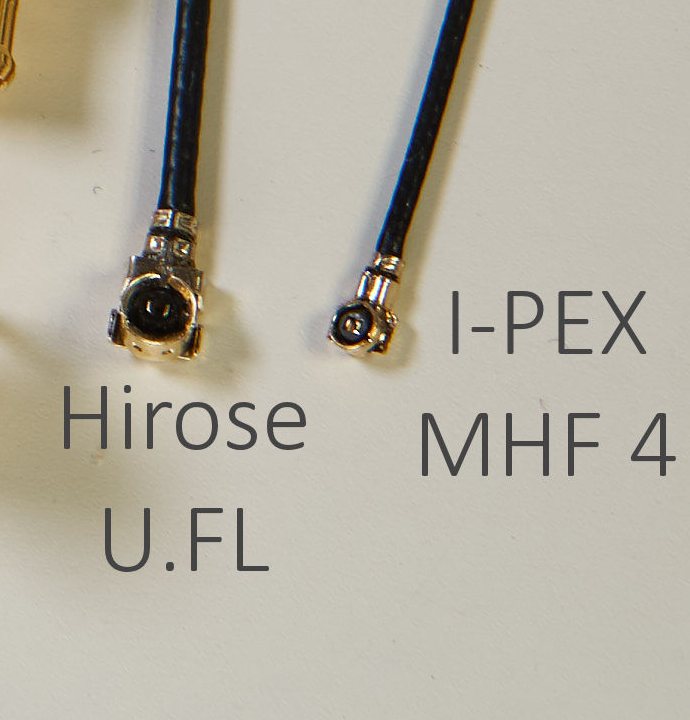
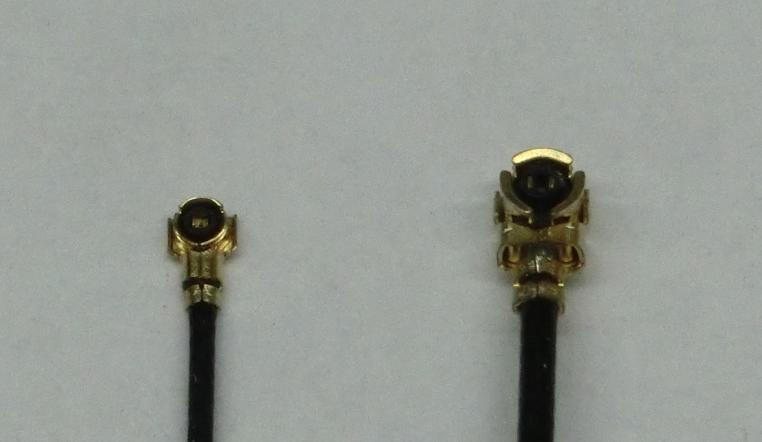
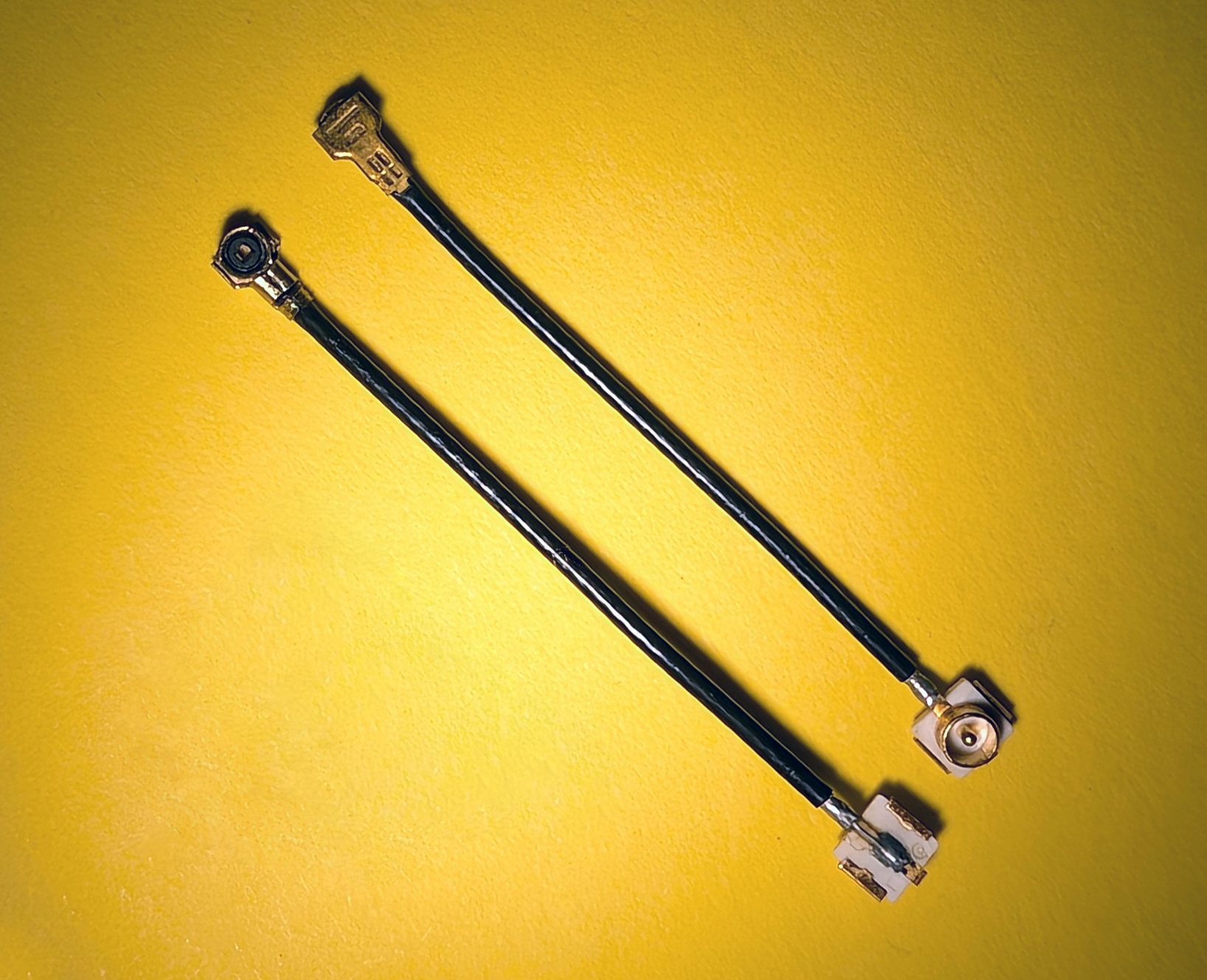
U.FL receptacle, the board half. The centre pin is why it counts as male. Photo: oomlout, CC BY-SA 2.0U.FL soldered to a Wi-Fi router board, with a match head for scale. Photo: Afrank99, CC BY-SA 3.0Cable plugs side by side: U.FL on the left, the much smaller MHF 4 on the right. Photo: Shabaz1000, CC BY-SA 4.0The same comparison up close: IPEX4 on the left, standard IPEX on the right. Photo: Mitja Stachowiak, CC030 mm adapter pigtails, MHF 4 plug at one end and U.FL receptacle at the other, both faces shown. These bridge the two sizes without pretending they mate. Photo: Siarhei Besarab, CC BY-SA 4.0
The default. Mated 2.4 mm nominal, 2.5 mm max; U.FL-LP(V) drops to 1.9 mm nominal. MHF 1 LK adds a slide-over mechanical lock. 30 cycles means 30: this is a build-once connector, not a test point.
Coupling
Plug cap snaps over the jack
Contacts
Jack carries the pin (male); plug carries the socket (female)
No openly licensed photo of this part turned up, so none is shown rather than a look-alike. Check the maker's datasheet.
Hirose's reduced-height U.FL cousin: 1.4 mm mated (1.5 mm max), with only 0.8 mm of plug standing off the board. Commonly treated as U.FL family, so confirm intermateability against the datasheet before you commit a build. At least one distributor copy of the datasheet is marked for discontinuation, so check availability too.
Coupling
Plug cap snaps over the jack
Contacts
Jack carries the pin (male); plug carries the socket (female)
Body
2.6 mm square
Land
3 × 3.1 mm
Plug / pin
Ø2 / Ø0.5 mm
Impedance
50 Ω
Also sold as
Hirose N.FL
IPEX 2Nothing else
not confirmed
not confirmed
DC – 6 GHz (typ.)
30 (typ.)
0.81 / 1.13 mm
No openly licensed photo of this part turned up, so none is shown rather than a look-alike. Check the maker's datasheet.
Genuinely rare. Lower profile than MHF I and broadly similar in construction, but its own interface: not a U.FL and not an MHF 4. If a listing offers you “MHF II” cheaply it is very often mislabelled MHF 4. Measure before believing.
Coupling
Plug cap snaps over the jack
Contacts
Jack carries the pin (male); plug carries the socket (female)
Impedance
50 Ω
Also sold as
MHF2IPEX2IPX2
IPEX 3MHF III; W.FL disputed
1.6
1.7 sq. 2×2.05 land
DC – 6 GHz
30 (typ.)
0.81 / 1.13 mm
No openly licensed photo of this part turned up, so none is shown rather than a look-alike. Check the maker's datasheet.
The contested one. Amphenol markets AMMC as mating with Hirose W.FL and I-PEX MHF III, while other vendors group W.FL with MHF 4. Both cannot be true. Treat MHF III / W.FL / AMMC cross-mating as unproven and sample it yourself.
Coupling
Plug cap snaps over the jack
Contacts
Jack carries the pin (male); plug carries the socket (female)
No openly licensed photo of this part turned up, so none is shown rather than a look-alike. Check the maker's datasheet.
Hirose's own: 1.4 mm or 1.65 mm nominal mated height (1.55 / 1.85 mm max) on a 2 × 2 mm land, less than half the board area of U.FL. Read the land-pattern trap before you lay out a board.
Coupling
Plug cap snaps over the jack
Contacts
Jack carries the pin (male); plug carries the socket (female)
Cable plugs side by side: U.FL on the left, the much smaller MHF 4 on the right. Photo: Shabaz1000, CC BY-SA 4.0The same comparison up close: IPEX4 on the left, standard IPEX on the right. Photo: Mitja Stachowiak, CC030 mm adapter pigtails, MHF 4 plug at one end and U.FL receptacle at the other, both faces shown. These bridge the two sizes without pretending they mate. Photo: Siarhei Besarab, CC BY-SA 4.0
The modern default for M.2, 5 GHz Wi-Fi and 5G modules. 1.2 mm mated, on 0.81 mm cable only. MHF 4 LK adds a mechanical lock. For thicker cable or 12 GHz, look at MHF 4L.
Coupling
Plug cap snaps over the jack
Contacts
Jack carries the pin (male); plug carries the socket (female)
DC – 12 GHz on a 4L receptacle DC – 9 GHz on an MHF 4 receptacle
30 (typ.)
0.64 / 0.81 / 0.95 / 1.13 / 1.37 mm
No openly licensed photo of this part turned up, so none is shown rather than a look-alike. Check the maker's datasheet.
MHF 4 with more bandwidth and more cable choices. Mated height follows the coax: 1.2 mm max on 0.64 and 0.81 mm cable, 1.4 mm on 0.95 and 1.13 mm, 1.7 mm on 1.37 mm. I-PEX lists it as intermateable with MHF 4.
Coupling
Plug cap snaps over the jack
Contacts
Jack carries the pin (male); plug carries the socket (female)
No openly licensed photo of this part turned up, so none is shown rather than a look-alike. Check the maker's datasheet.
1.0 mm mated (MHF 5L: 1.3 mm), about as small as a cable-to-board RF connector gets in volume production. Explicitly not compatible with W.FL or W.FL2 despite sharing their land pattern.
Coupling
Plug cap snaps over the jack
Contacts
Jack carries the pin (male); plug carries the socket (female)
No openly licensed photo of this part turned up, so none is shown rather than a look-alike. Check the maker's datasheet.
A third interface sharing the W.FL / X.FL land pattern at 1.2 mm mated height, and mating with neither of them. It is listed here mainly so you know it exists.
Coupling
Plug cap snaps over the jack
Contacts
Jack carries the pin (male); plug carries the socket (female)
DC – 11 GHz IL 0.15 dB to 2.5 GHz, 0.40 dB to 11 GHz
100 (receptacle)
0.81 mm
No openly licensed photo of this part turned up, so none is shown rather than a look-alike. Check the maker's datasheet.
Not an antenna connector but a normally-closed RF switch. The trace passes straight through until you insert a probe, which breaks the path and routes the signal out. This is what you want as a production test point instead of abusing a U.FL.
Coupling
Probe snaps onto a switch
Contacts
Jack carries the pin (male); plug carries the socket (female)
No openly licensed photo of this part turned up, so none is shown rather than a look-alike. Check the maker's datasheet.
The bigger, tougher switch connector: 3.9 mm tall, self-aligning to ±0.5 mm, and rated for twelve thousand cycles. Built for cradle test fixtures and external-antenna sockets in handsets.
Coupling
Probe snaps onto a switch
Contacts
Jack carries the pin (male); plug carries the socket (female)
Impedance
50 Ω
Also sold as
MS-147-C(LP)
MMCX only
≈3.5
Ø2.4
DC – 6 GHz
500
RG-178, RG-316, 1.13 / 1.37 mm, 0.047″ semi-rigid
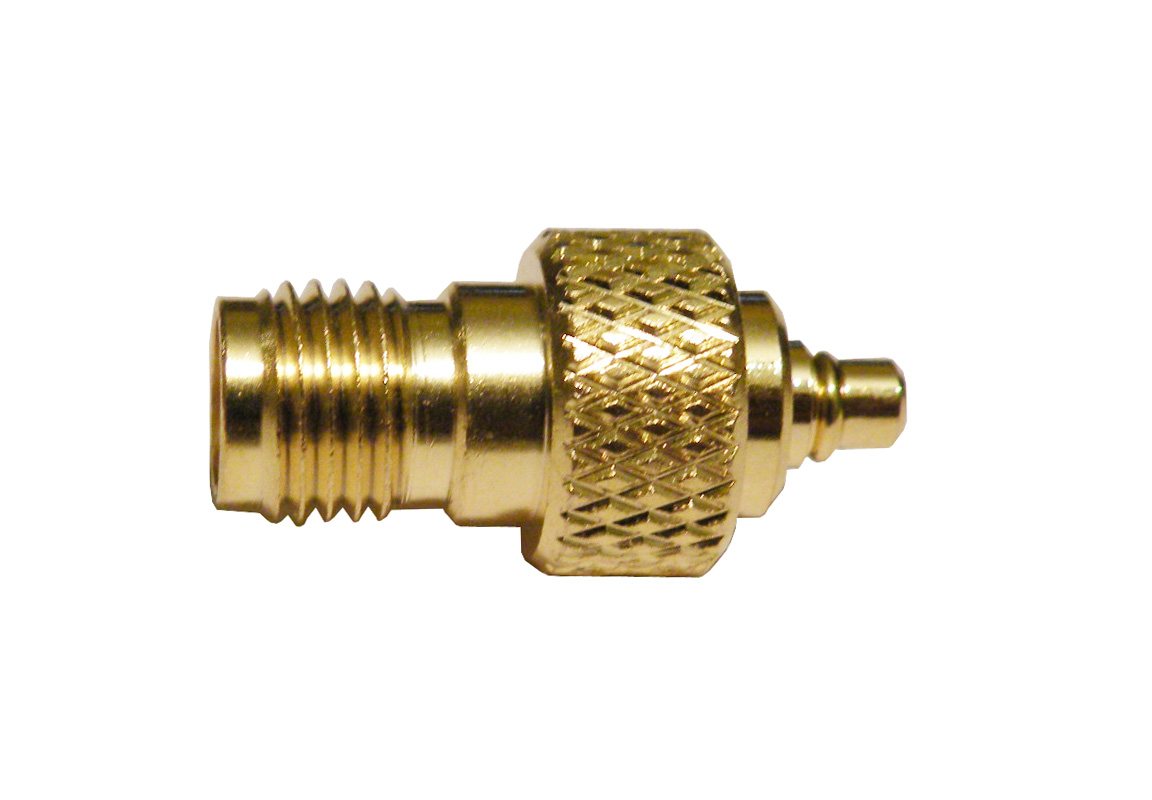
An MMCX plug, at the right end of an adapter. The threaded SMA jack on the left shows how much smaller it is. Photo: Electronicgrup, CC BY-SA 3.0
The sweet spot for anything you will unplug more than once. Snap-on, with a lock-snap that rotates a full 360° after mating, so you can dress the cable in any direction. Shallow engagement means it pops off more easily than MCX.
Coupling
Plug barrel snaps into the jack
Contacts
Jack carries the socket (female); plug carries the pin (male)
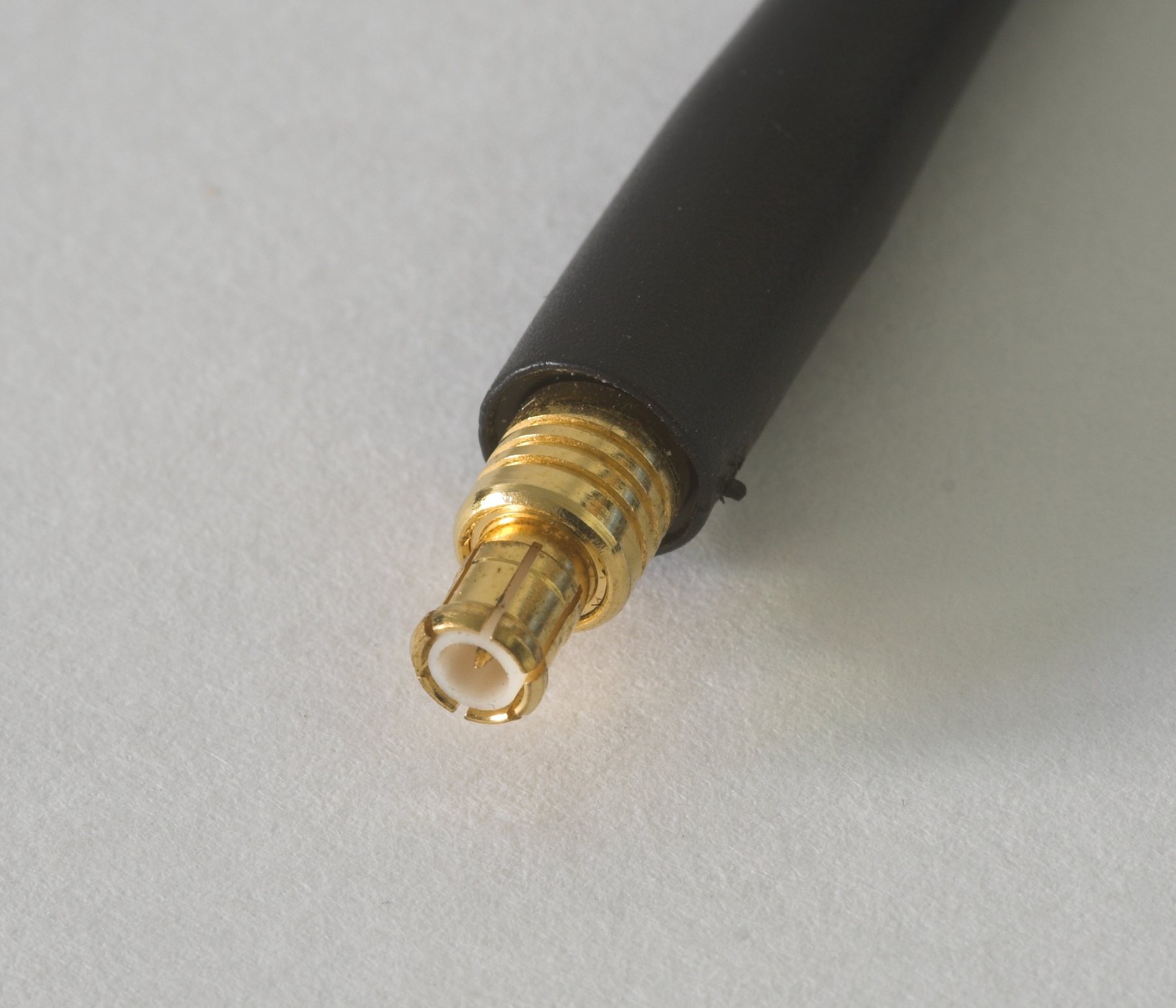
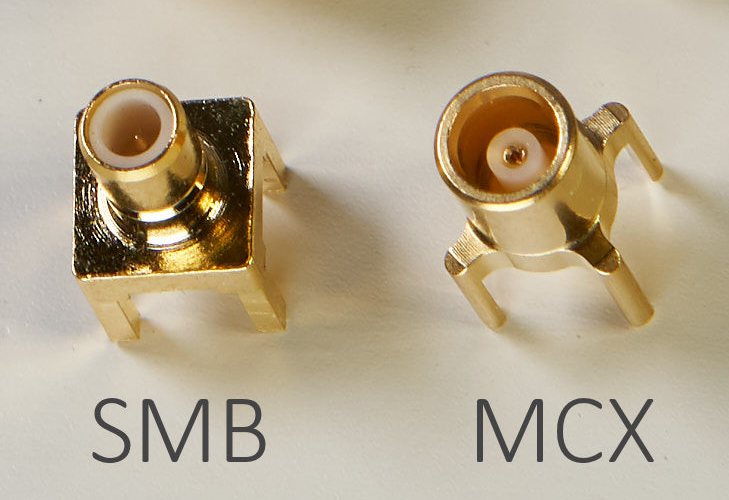
MCX cable plug. The slotted barrel is what snaps into the jack. Photo: Afrank99, CC BY-SA 2.5SMB and MCX board connectors. Both are snap-ons, and they don't mate each other. Photo: Shabaz1000, CC BY-SA 4.0
MMCX's larger, sturdier parent: a 3.6 mm coupling against 2.4 mm, deeper engagement, and a noticeably beefier centre contact that resists bending. Available in 75 Ω as well as 50 Ω, which MMCX generally is not.
Coupling
Plug barrel snaps into the jack
Contacts
Jack carries the socket (female); plug carries the pin (male)
Coupling Ø
3.6 mm
Impedance
50 Ω / 75 Ω
Also sold as
CECC 22220IEC 61169-36MIL-STD-348 interface
SMA only
≈8
Ø6.35
DC – 18 GHz (flex) to 26.5 GHz (semi-rigid)
500
RG-174, RG-178, RG-316, RG-402, RG-405
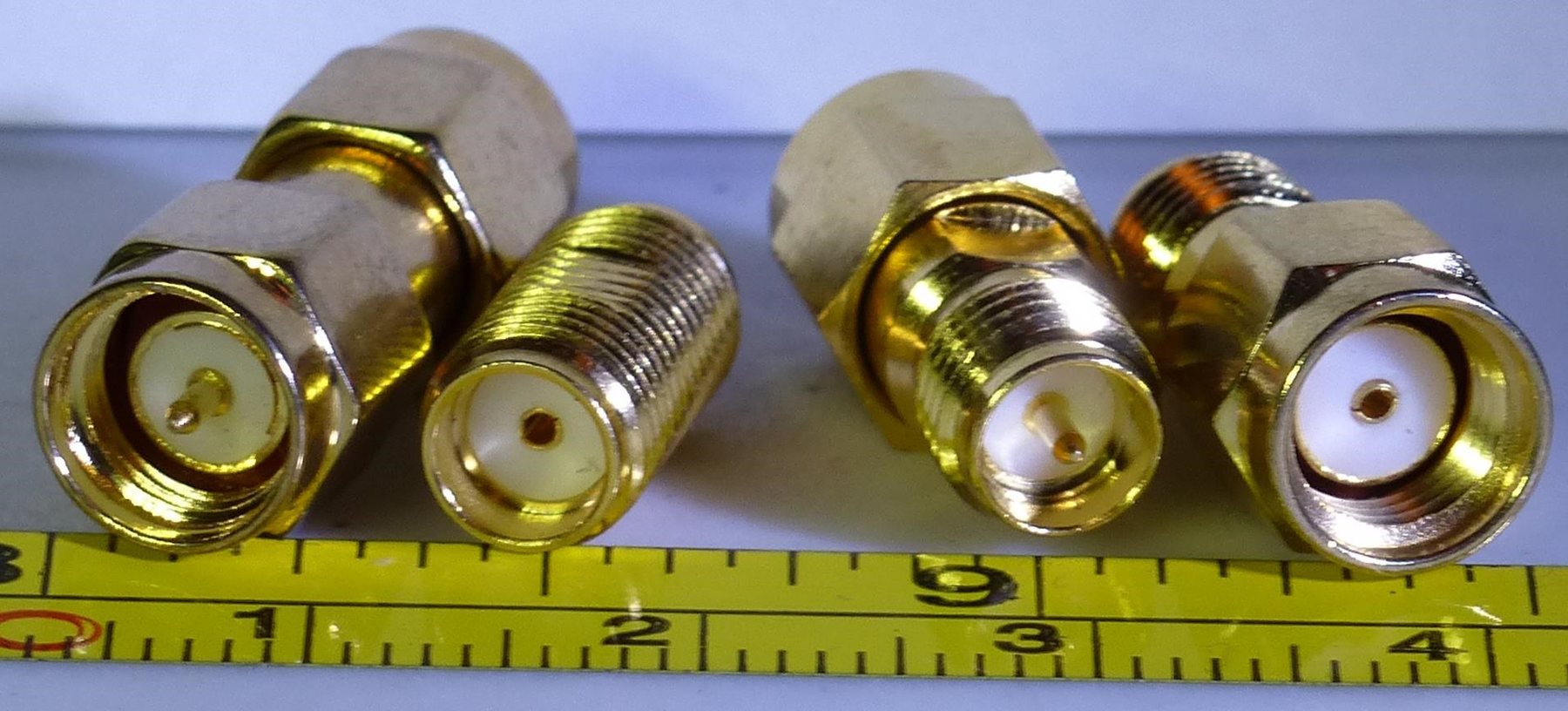
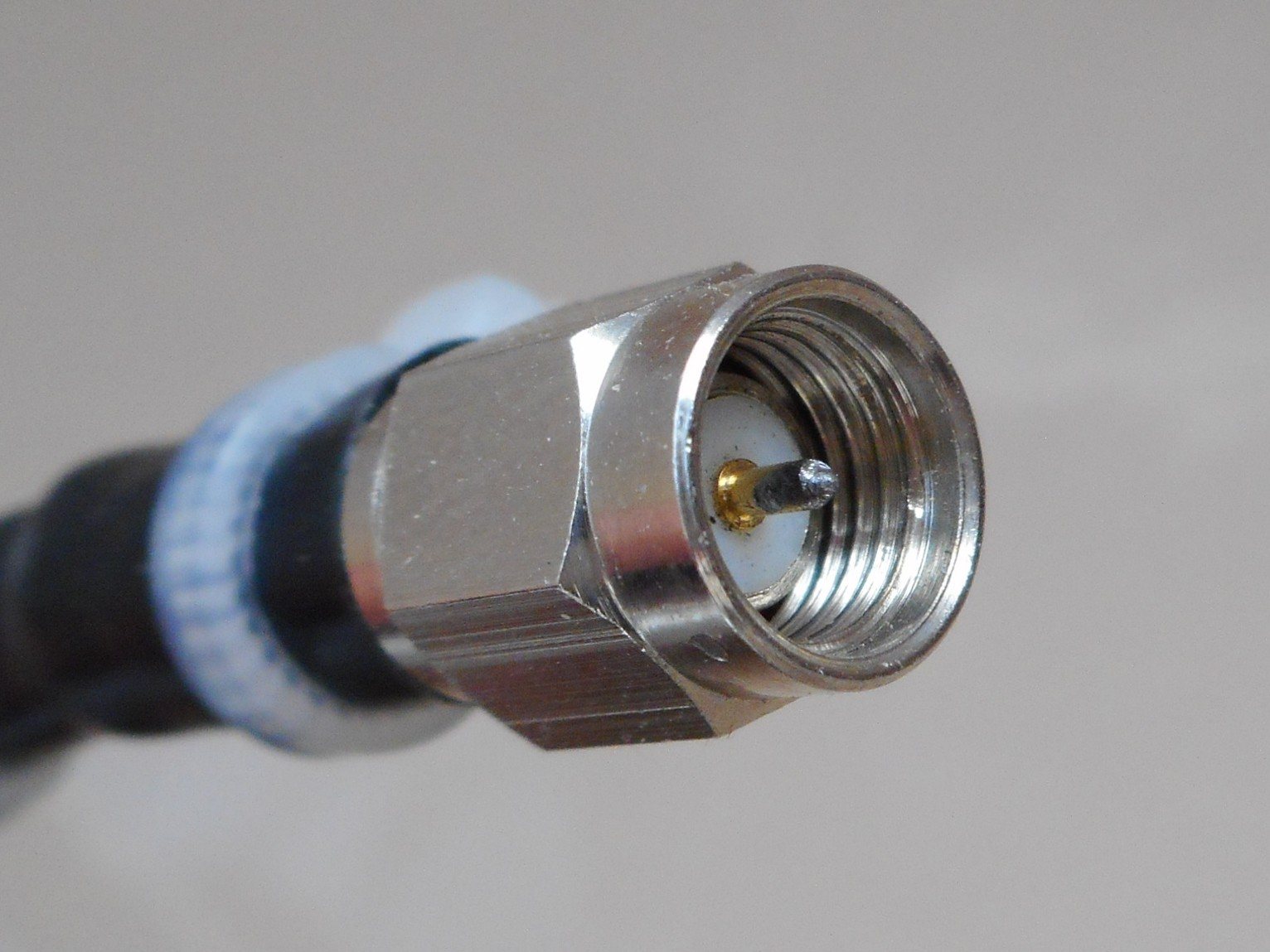
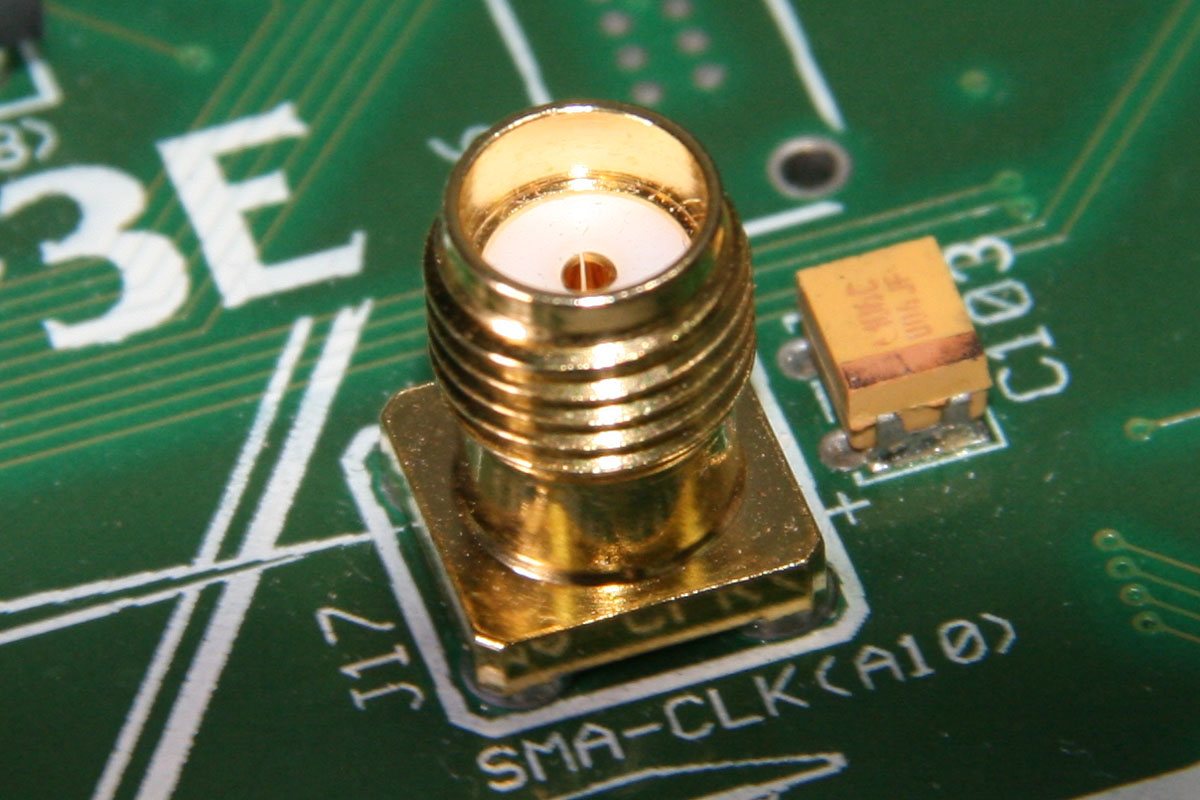
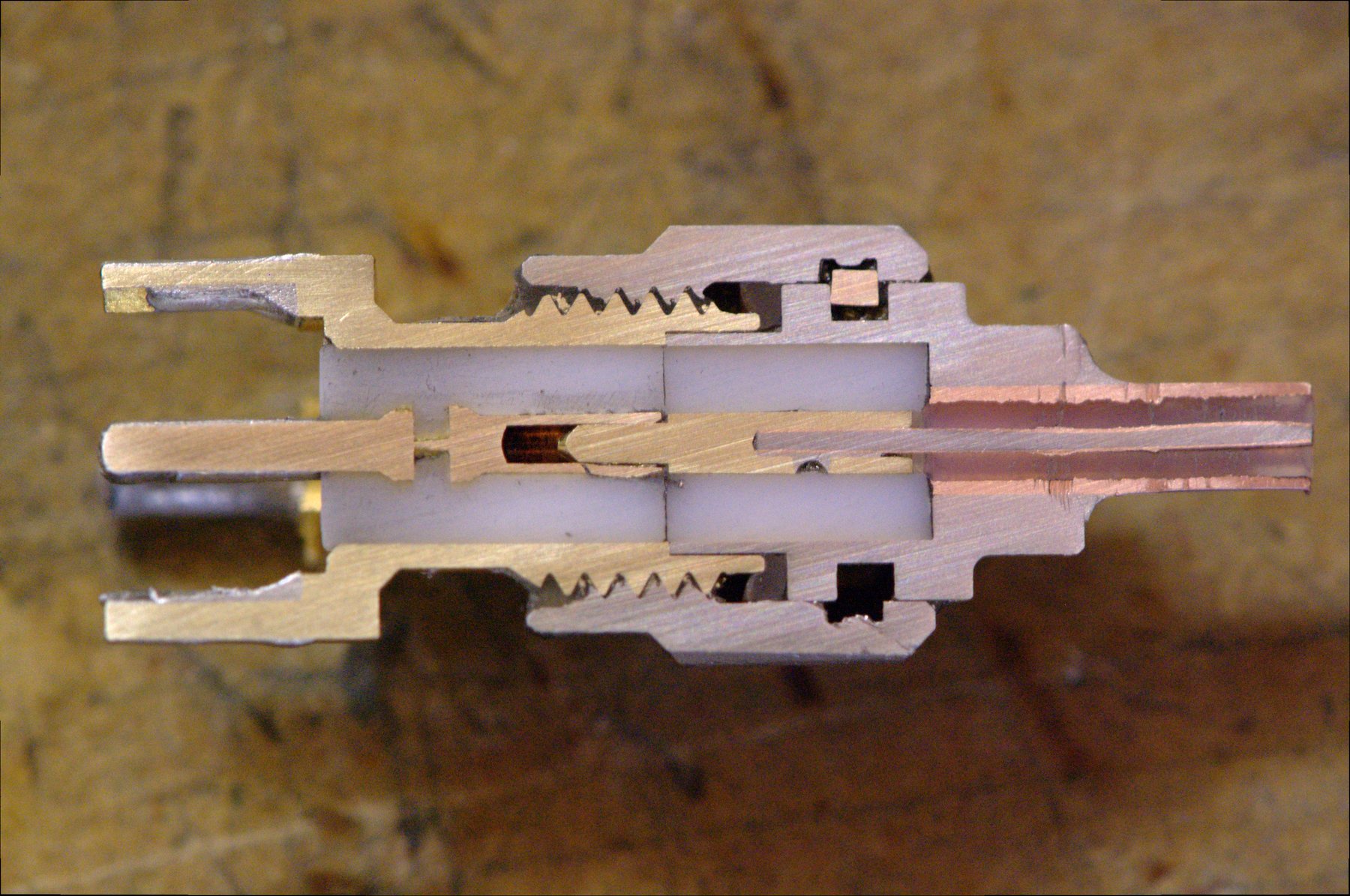
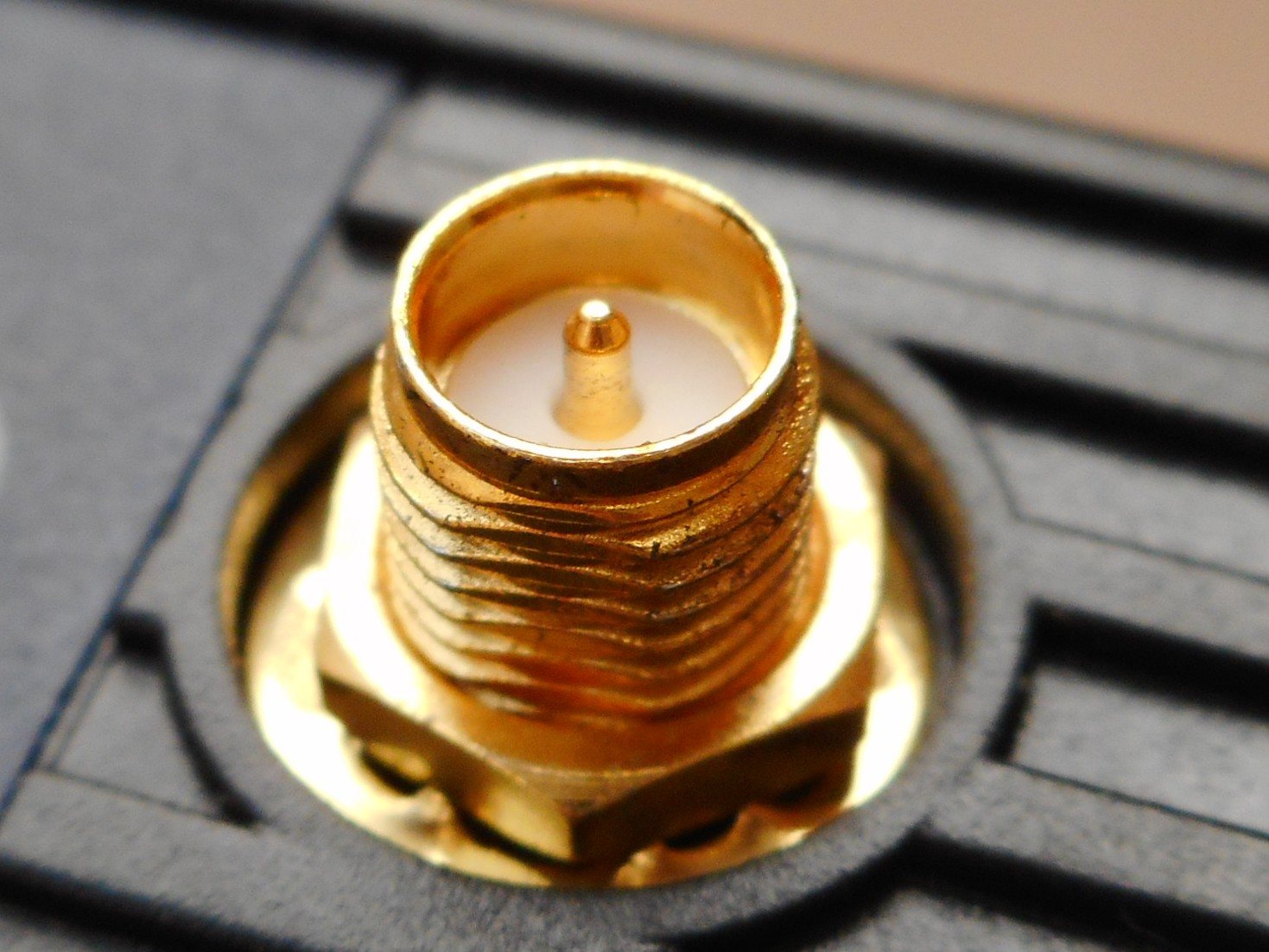
The trap in one picture. Left to right: SMA male, SMA female, RP-SMA female, RP-SMA male. Look at where the pins are. Photo: DJH16W, CC BY-SA 4.0SMA plug on cable: internal threads, centre pin. Photo: Markus Bärlocher, CC0SMA jack on a dev board: external threads, centre socket. Photo: Jlochoap, CC BY-SA 3.0A real SMA mated pair sawn in half: the coupling nut's threads, the white dielectric, and the pin seated in its socket. Photo: TubeTimeUS, CC BY-SA 4.0
The threaded workhorse and the usual far end of a U.FL pigtail. Its reverse-polarity twin keeps these threads and swaps the contacts, so check before you tighten.
Coupling
1/4-36 screw thread
Contacts
Jack carries the socket (female); plug carries the pin (male)
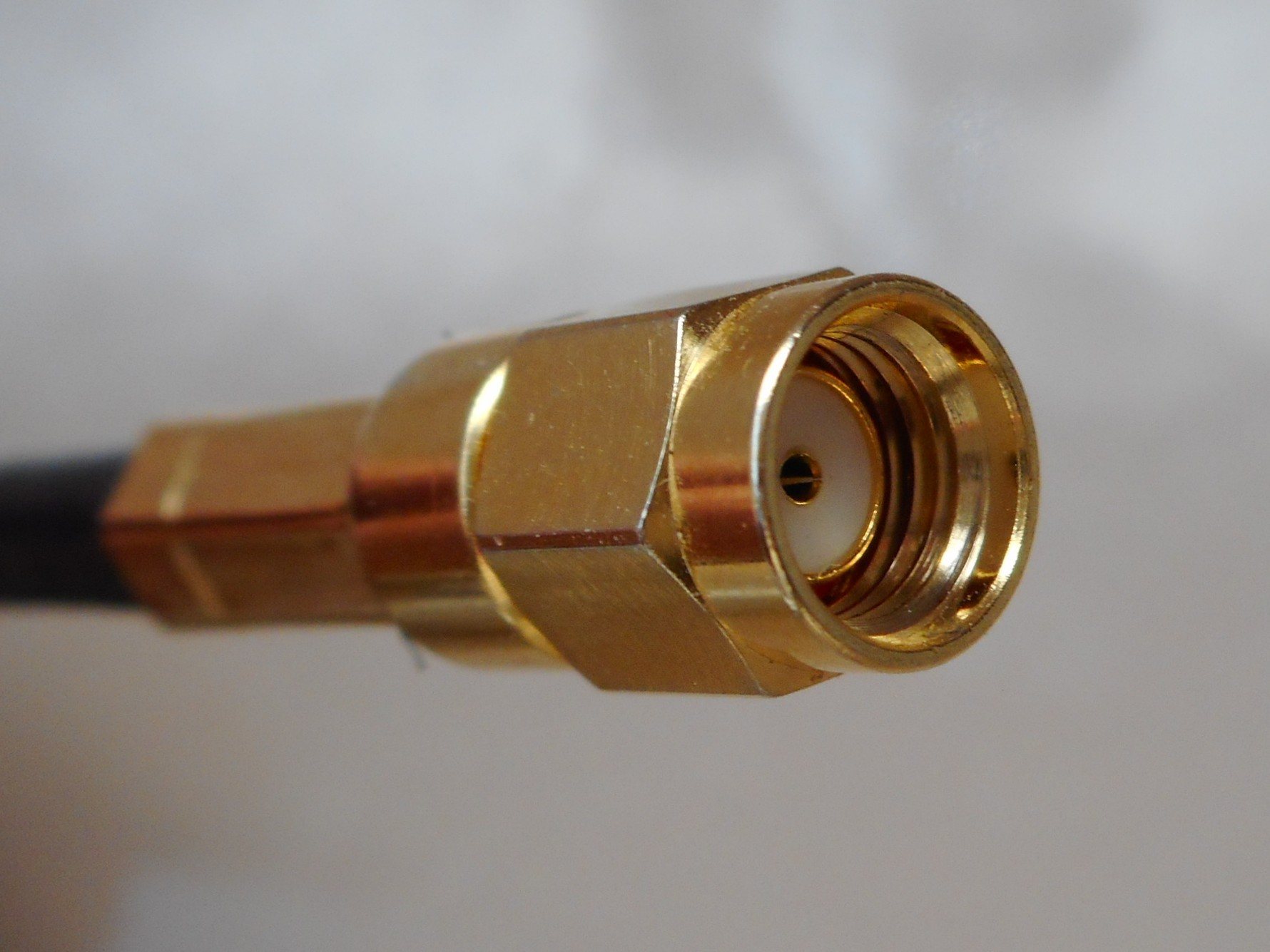
The trap in one picture. Left to right: SMA male, SMA female, RP-SMA female, RP-SMA male. Look at where the pins are. Photo: DJH16W, CC BY-SA 4.0RP-SMA plug: the same thread as SMA, but a socket where the pin should be. Photo: Markus Bärlocher, CC0RP-SMA jack on a Wi-Fi router: external threads, with a pin where the socket should be. Photo: Markus Bärlocher, CC0
Same threads as SMA with the contacts swapped: the plug carries a socket and the jack carries a pin. Common on consumer Wi-Fi routers and antennas.
Coupling
1/4-36 screw thread
Contacts
Jack carries the pin (male); plug carries the socket (female)
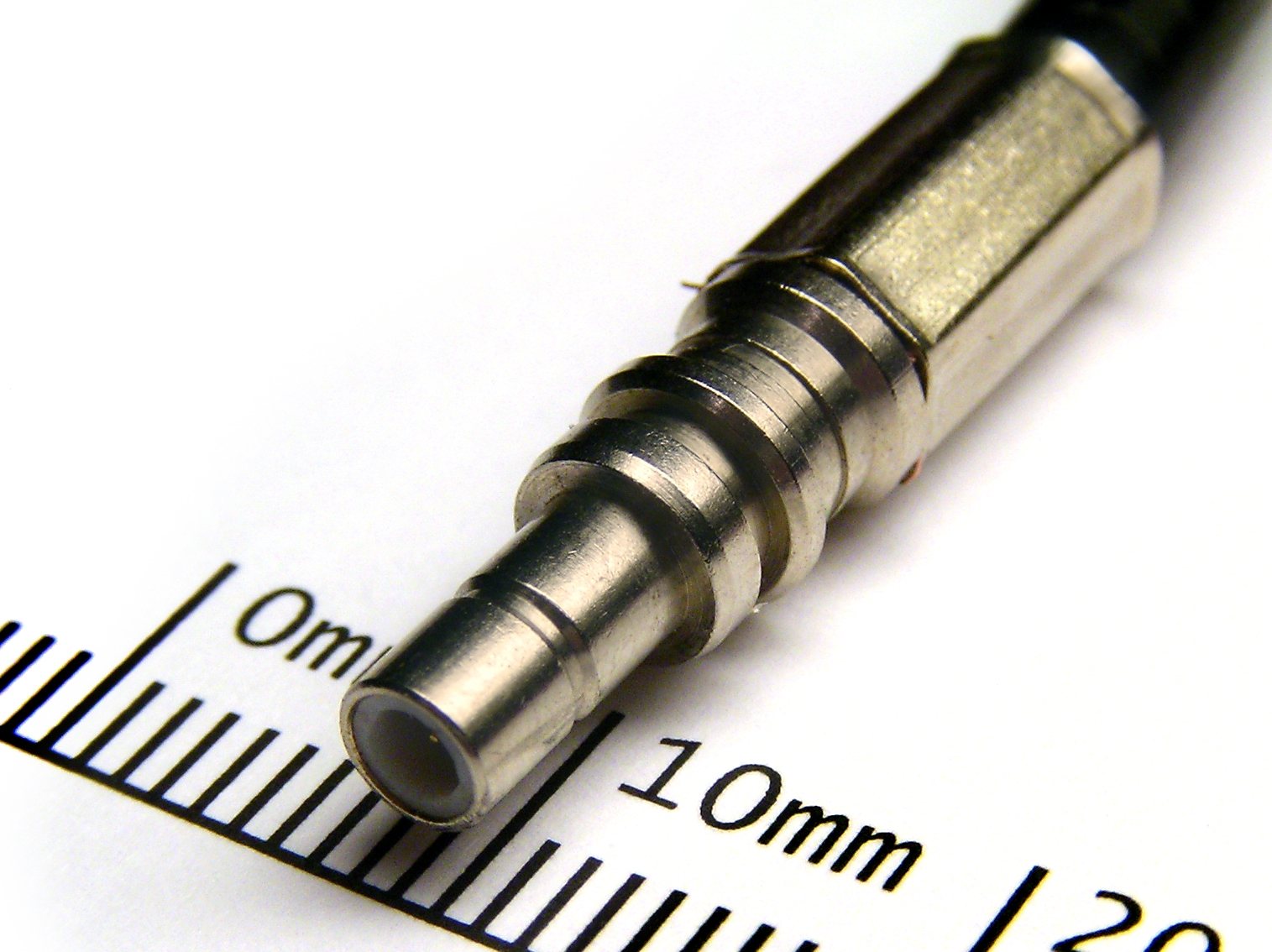
SMB and MCX board connectors. Both are snap-ons, and they don't mate each other. Photo: Shabaz1000, CC BY-SA 4.0SMB connector crimped to coax, lying on a millimetre scale. Photo: Petteri Aimonen, Public domain
An older snap-on, slightly larger than MCX (about 5 mm coupling) and capped around 4 GHz, which is why MCX largely replaced it. Still common in telecom and automotive legacy gear.
Coupling
Plug barrel snaps into the jack
Coupling Ø
≈5 mm
Impedance
50 Ω / 75 Ω
Also sold as
subminiature-BSSMB (scaled-down version)
SMP only
not confirmed
not confirmed
DC – 40 GHz
100 – 500 (by detent)
0.047″ / 0.085″ semi-rigid, RG-405, RG-174
No openly licensed photo of this part turned up, so none is shown rather than a look-alike. Check the maker's datasheet.
Blind-mate push-on connector from the defence and instrumentation world. Sold in full-detent, limited-detent and smooth-bore retention grades; mixing grades across a mated pair is normal and intentional. GPO is the Corning Gilbert trade name for this interface.
Coupling
Push-on, blind-mate
Impedance
50 Ω
Also sold as
GPO®
SMPM only
not confirmed
not confirmed
DC – 65 GHz
100 – 500 (by detent)
0.047″ / 0.085″ semi-rigid, RG-405, RG-174
No openly licensed photo of this part turned up, so none is shown rather than a look-alike. Check the maker's datasheet.
The smaller SMP size, with the same retention grades. GPPO is the Corning Gilbert trade name. Never mates across to SMP or SMPS.
Coupling
Push-on, blind-mate
Impedance
50 Ω
Also sold as
GPPO®mini-SMPSSMP®MSSP
SMPS only
not confirmed
not confirmed
DC – 100 GHz
100 – 500 (by detent)
0.047″ / 0.085″ semi-rigid, RG-405, RG-174
No openly licensed photo of this part turned up, so none is shown rather than a look-alike. Check the maker's datasheet.
The smallest SMP size. SMP3 and G3PO are the same thing; SMPS is close but not guaranteed identical, and has caused field problems under shock and vibration in mission-critical use.
Coupling
Push-on, blind-mate
Impedance
50 Ω
Also sold as
G3PO®SMP3
Nothing matches those limits.
Actual size
Calibrate once and you can hold a part up to the screen. Without calibrating, sizes are approximate.
Calibrate to your screen
Hold a bank card against the screen and move the slider until the outline matches its width.
85.6 mm
Photos
Real parts, not to scale with each other. Select one to see it full size. H.FL, N.FL, MHF II, MHF III, W.FL, MHF 4L, X.FL, W.FL2, the MS switches and the SMP family are missing because no openly licensed photo of them turned up.
U.FL receptacle, the board half. The centre pin is why it counts as male. Photo: oomlout, CC BY-SA 2.0U.FL soldered to a Wi-Fi router board, with a match head for scale. Photo: Afrank99, CC BY-SA 3.0Cable plugs side by side: U.FL on the left, the much smaller MHF 4 on the right. Photo: Shabaz1000, CC BY-SA 4.0The same comparison up close: IPEX4 on the left, standard IPEX on the right. Photo: Mitja Stachowiak, CC030 mm adapter pigtails, MHF 4 plug at one end and U.FL receptacle at the other, both faces shown. These bridge the two sizes without pretending they mate. Photo: Siarhei Besarab, CC BY-SA 4.0An MMCX plug, at the right end of an adapter. The threaded SMA jack on the left shows how much smaller it is. Photo: Electronicgrup, CC BY-SA 3.0MCX cable plug. The slotted barrel is what snaps into the jack. Photo: Afrank99, CC BY-SA 2.5SMB and MCX board connectors. Both are snap-ons, and they don't mate each other. Photo: Shabaz1000, CC BY-SA 4.0SMB connector crimped to coax, lying on a millimetre scale. Photo: Petteri Aimonen, Public domainThe trap in one picture. Left to right: SMA male, SMA female, RP-SMA female, RP-SMA male. Look at where the pins are. Photo: DJH16W, CC BY-SA 4.0SMA plug on cable: internal threads, centre pin. Photo: Markus Bärlocher, CC0SMA jack on a dev board: external threads, centre socket. Photo: Jlochoap, CC BY-SA 3.0A real SMA mated pair sawn in half: the coupling nut's threads, the white dielectric, and the pin seated in its socket. Photo: TubeTimeUS, CC BY-SA 4.0RP-SMA plug: the same thread as SMA, but a socket where the pin should be. Photo: Markus Bärlocher, CC0RP-SMA jack on a Wi-Fi router: external threads, with a pin where the socket should be. Photo: Markus Bärlocher, CC0
Mating groups
Blue is well established, amber means vendors disagree or sizes split, and red means nothing crosses over.
Freely intermateable. Amphenol states AMC is 100% compatible with Hirose U.FL and I-PEX MHF. This is the group nearly everyone means by “IPEX” or “ufl”. N.FL is the reduced-height cousin: confirm it against the datasheet.
MHF 4 and MHF 4L are intermateable per I-PEX. W.FL is routinely cross-sold as equivalent and generally works, but the mated heights differ and Amphenol maps its AMMC to MHF III instead. Sample before a production run.
Intermateable within each size, never across sizes. G3PO and SMP3 are identical; SMPS is near-identical but has caused field problems under shock and vibration in mission-critical use.
W.FL, W.FL2 and X.FL use the same PCB footprint and do not intermate. Hirose says so explicitly in the W.FL datasheet. A board can pass DFM, assemble cleanly, and still reject every pigtail you own. Specify the mating interface on the schematic symbol, not just the land.
Reverse-polarity SMA keeps the threads and swaps the contacts: the RP-SMA plug carries a socket and the RP-SMA jack carries a pin. A mixed pair mates mechanically and does nothing electrically. It began as a regulatory dodge for consumer Wi-Fi and now mostly catches the unwary.
U.FL and its clones are rated around 30 mating cycles, and the receptacle is the part that wears. If a connector will be touched repeatedly, put an MS-156C switch connector or a bulkhead SMA there instead, and use the U.FL only for the permanent internal run.
Marketplace listings use IPEX for anything in the family. Insist on a generation: IPEX1/MHF1, IPEX4/MHF4, IPEX5/MHF5. IPEX 1 and IPEX 4 differ by 1.3 mm of mated height and a whole footprint, and they don't mate.
Mated height and loss both depend on the coax. MHF 4L on 0.81 mm cable is 1.2 mm tall; the same connector on 1.37 mm cable is 1.7 mm. If you are fighting for clearance under a heat spreader, the cable choice matters as much as the connector.
The U.FL family inverts the usual RF convention. On U.FL the board part is a jack by position but male by contact, since it carries the centre pin, while the cable plug carries the socket and is female. On MMCX, MCX and SMA it is the other way round: board jack female, cable plug male. The same two words mean opposite hardware depending on which family you are holding, so order by manufacturer part number, never by the word “male” alone.
AMMC, W.FL and MHF III. Amphenol markets AMMC as mating both W.FL and MHF III. Other vendors group W.FL with MHF 4. Unresolved: sample it.
W.FL and MHF 4 height. Sold as equivalents, but W.FL is 1.4 or 1.65 mm nominal against 1.2 mm for MHF 4.
U.FL bandwidth. Hirose gives DC – 6 GHz and I-PEX gives DC – 9 GHz for the same interface. The 18 GHz figure for U.FL(A) could not be confirmed from current sources, so the frequency filter ignores it.
N.FL and U.FL. Commonly treated as one family, without a clear statement that the standard parts mate. Confirm against the datasheet.
SMPS and G3PO. Often listed as the same interface. G3PO and SMP3 are identical; SMPS is near-identical but has caused field problems under shock and vibration.
Sources
Hirose U.FL, U.FL-K, W.FL and X.FL series pages and catalogues (hirose.com); I-PEX MHF I, MHF 4 and MHF 4L product pages (i-pex.com); Amphenol RF ultraminiature series AMC, AMMC and AMC4 (amphenolrf.com, digikey.com product highlight); Hirose MS-147 and MS-156C data via RS Components and DigiKey; Wikipedia “Hirose U.FL” alias tables; Coaxicom MCX and MMCX specifications; SV Microwave SMP, SMPM and SMPS application note; Corning Gilbert GPO, GPPO and G3PO naming via Design World and Connector Tips.
Figures marked “typ.” are family conventions rather than per-part guarantees. Drawings are built from the dimensions in the table and are to scale on the outside, but they are schematics, not mechanical outlines. Always confirm against the datasheet for your exact part number.
Photo credits
All from Wikimedia Commons. Adapted versions here are shared under the same licence as the original.