Acoustic Transducer
Nemo: An Underwater Communication Device. University of California, Irvine, with Kaustabh Simba and Michelle Tran, advised by Professor Michael Green.
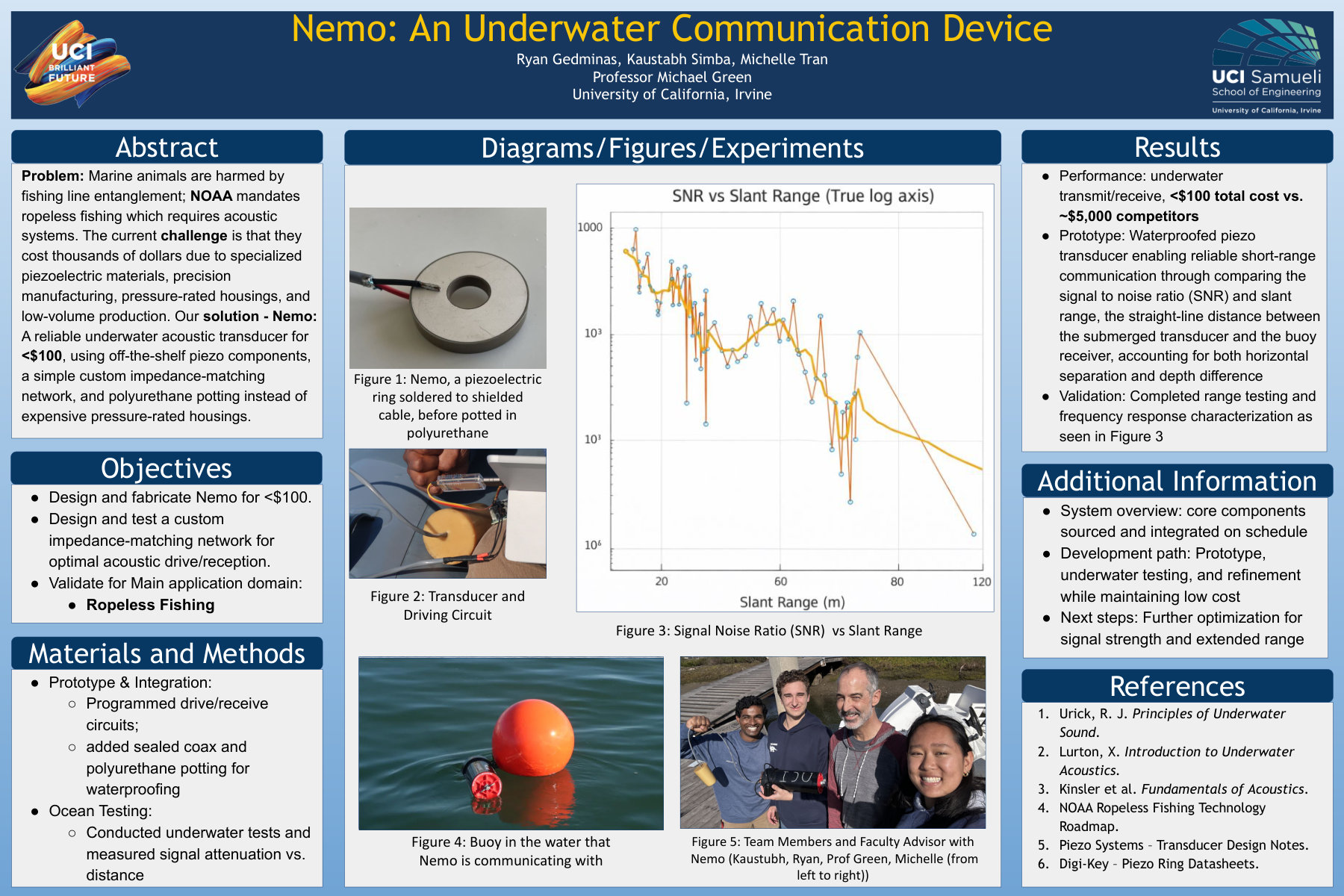
Fishing line entanglement harms marine animals. Ropeless fishing avoids the lines, but it depends on underwater acoustic systems that cost thousands of dollars because of specialized piezoelectric materials, precision manufacturing, pressure-rated housings and low-volume production. Nemo is our attempt at a reliable acoustic transducer for under $100.
Summary
- Design. Nemo uses an off-the-shelf piezoelectric ring soldered to shielded cable, with a simple custom impedance-matching network for driving and receiving. Polyurethane potting and sealed coax waterproof it in place of an expensive pressure-rated housing.
- Testing. We programmed the drive and receive circuits, then ran ocean tests against a buoy receiver, measuring signal attenuation with distance and signal to noise ratio against slant range, the straight-line distance between the submerged transducer and the buoy.
- Results. The prototype transmitted and received underwater with reliable short-range communication, for under $100 in total against about $5,000 for competing systems. We completed range testing and frequency response characterization.
- Next steps. Further optimization for signal strength and extended range, while keeping the cost low.
Poster